



Trying to send a video through text should be as simple as attaching a file and tapping send. But depending on how you choose to send it, your message may stall, fail with a “Not Delivered” notification, or look like it was recorded on a flip phone upon receipt—even though your phone is new, your signal is strong, and the video is less than a minute long.
In most cases, the problem isn’t your device or your connection; it’s how you send the message. Depending on your phone, your recipient’s phone, and the messaging app you’re using, video messages can be sent in a few different ways, and not all of them handle modern video files equally well.
If you want to avoid issues when sending videos via your texting apps, you need to choose the right way to share the content. In this article, we’ll show you the most reliable ways to send videos through iPhone and Android, and help you decide whether attaching a video or sending a link is the better option.

Learn how Heymarket can help your business build strong connections with texting.
Book a demoWhy do my videos fail to send through text or arrive blurry?
When something goes wrong as you’re texting a video to someone, the most likely cause is the file size.
Even short videos recorded on modern phones can be surprisingly large, especially if they’re high resolution. In certain text conversations, those files are delivered using MMS, an older carrier-based system with strict size limits—small enough that even a few seconds of high-quality video can exceed them. In those cases, the video may fail to send entirely or be compressed heavily so it can go through.
That’s why the most reliable way to send longer videos usually isn’t to attach them, but to share them in a way that doesn’t rely on MMS.
How to send a long video through text on iPhone
On an iPhone, the best method depends on who you’re sending the video to. If the recipient also has an iPhone and your messages are going through iMessage (blue bubbles), attaching a short video can work fine. But if you’re sending to an Android phone—or you’ve seen prior iMessage videos fail to send or arrive heavily compressed—the most reliable option is to share a link instead of the full file.
How to send long videos through text for individuals
There are a few different options for sending long videos as part of personal text messages, including native solutions for iPhones and Androids as well as third-party apps.
Before continuing, be sure you have MMS enabled and cellular data turned on for your iPhone or Android device.
Option 1: Share an iCloud link from Photos (best for longer videos and cross-platform delivery)
If your goal is to get the video delivered quickly and in good quality, iCloud links are usually the simplest path. iPhones can generate an iCloud link right from Photos, which you can paste into a text message like any other link.
To do it:
- Open Photos and find the video you want to send. Tap Share.
- Select Copy iCloud Link (your phone may take a moment to upload and generate the link).
- Paste the link into Messages and send it.
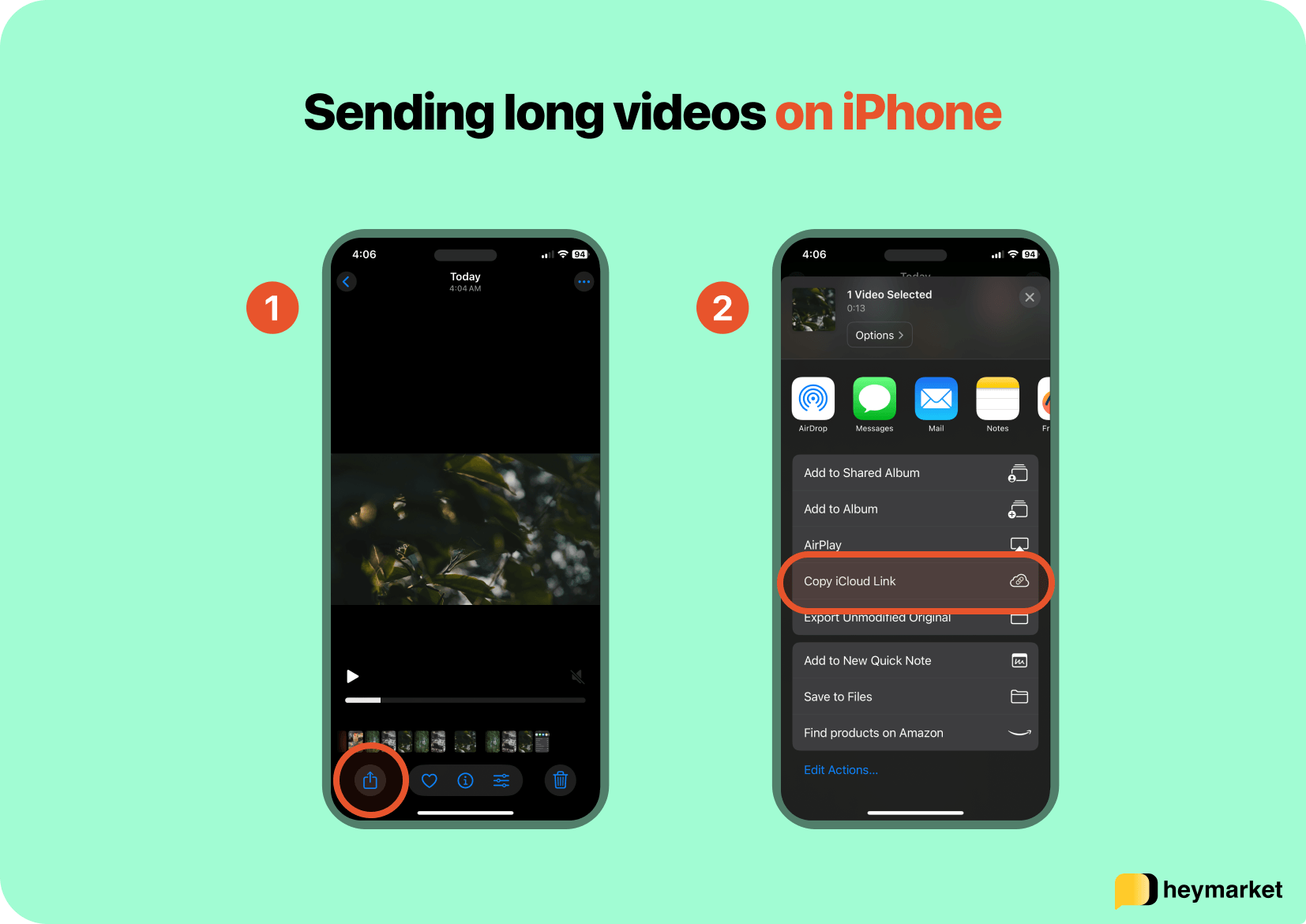 Note: iCloud links are available for 30 days, and you may need iCloud Photos turned on to see the iCloud link option.
This method is great when the video is longer than a quick clip, or when you’re texting someone on a different type of phone. Instead of relying on MMS, you’re sending something the recipient can open on any device.
Option 2: Attach the video in Messages (works best iPhone to iPhone)
If you’re sending a video to another iPhone user and the conversation is using iMessage (blue bubbles), attaching the video directly can work. In those cases, Messages generally handles video sharing better than MMS, and shorter clips often send without much issue.
To attach a video:
- Open Messages.
- Select the conversation.
- Tap the Photos button (or the “+” menu, depending on your version of iOS).
- Choose your video(s), then tap Done (if the video doesn’t appear in the text box automatically)
- Press send once the video appears in the text box.
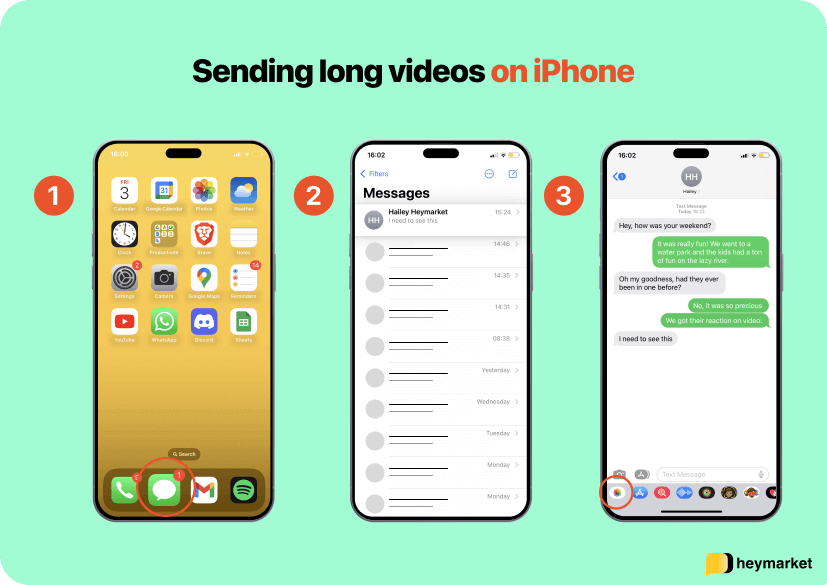

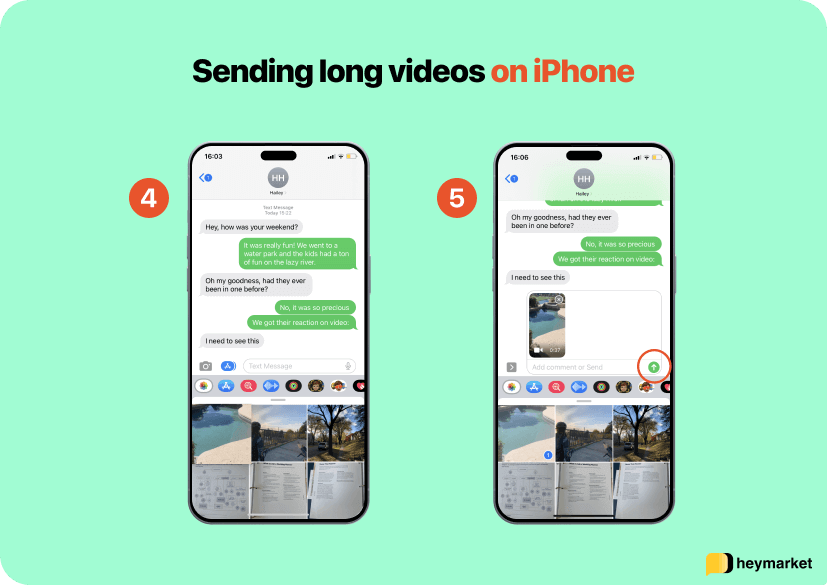
If your messages are green, the conversation may be using SMS/MMS—meaning you’re more likely to hit size limits or see quality drop. When that happens, switching to the iCloud link method is usually the safer choice.
Option 3: Use AirDrop if you’re nearby (fastest for full-quality transfer)
When you’re in the same physical location as your recipient, AirDrop is often the quickest way to share a large video at full quality. It doesn’t depend on texting at all, and it avoids any compression that can happen in messaging apps.
To use AirDrop:
- Open Photos, select the video, and tap Share.
- Tap AirDrop and select the recipient.
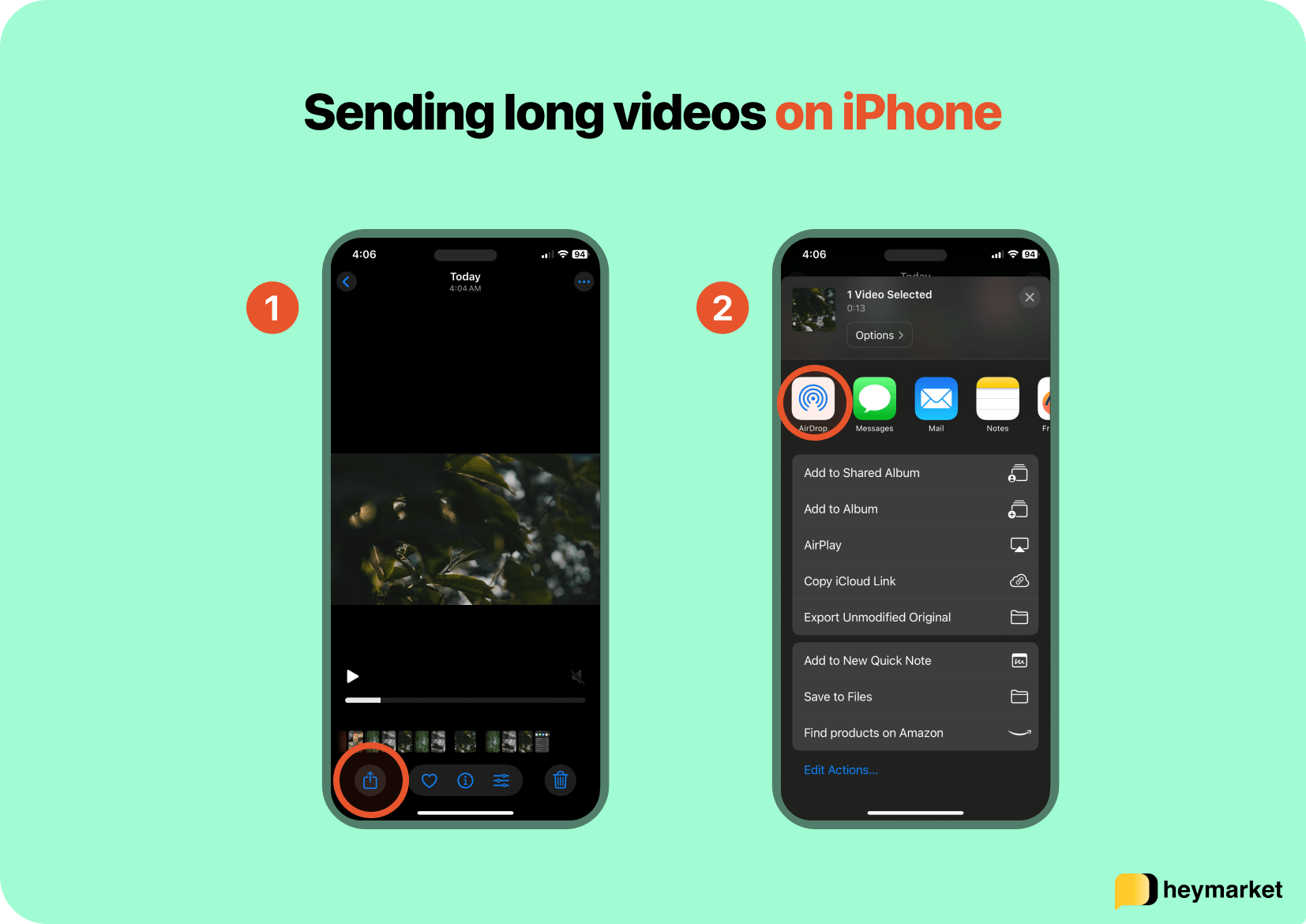

If you’re trying to send a long video in person, AirDrop is usually the fastest option.
How to send a video through text on Android
On Android, your sending options depend on the messaging app and features available in that conversation. Some Android messaging apps support rich chat features like Rich Communication Services (RCS), which allow larger attachments and higher-quality media when both the sender and recipient have it enabled.
When those features aren’t available, the conversation may fall back to MMS, which has much stricter size limits and often compresses video heavily. That’s why a video can send without issue in one thread and fail—or lose quality—in another.
Because of this variability, the most reliable way to send a long video on Android is usually to share a link rather than attach the video file. If the video is short and the conversation supports rich chat features, attaching it may work. Otherwise, link sharing is the safer option.
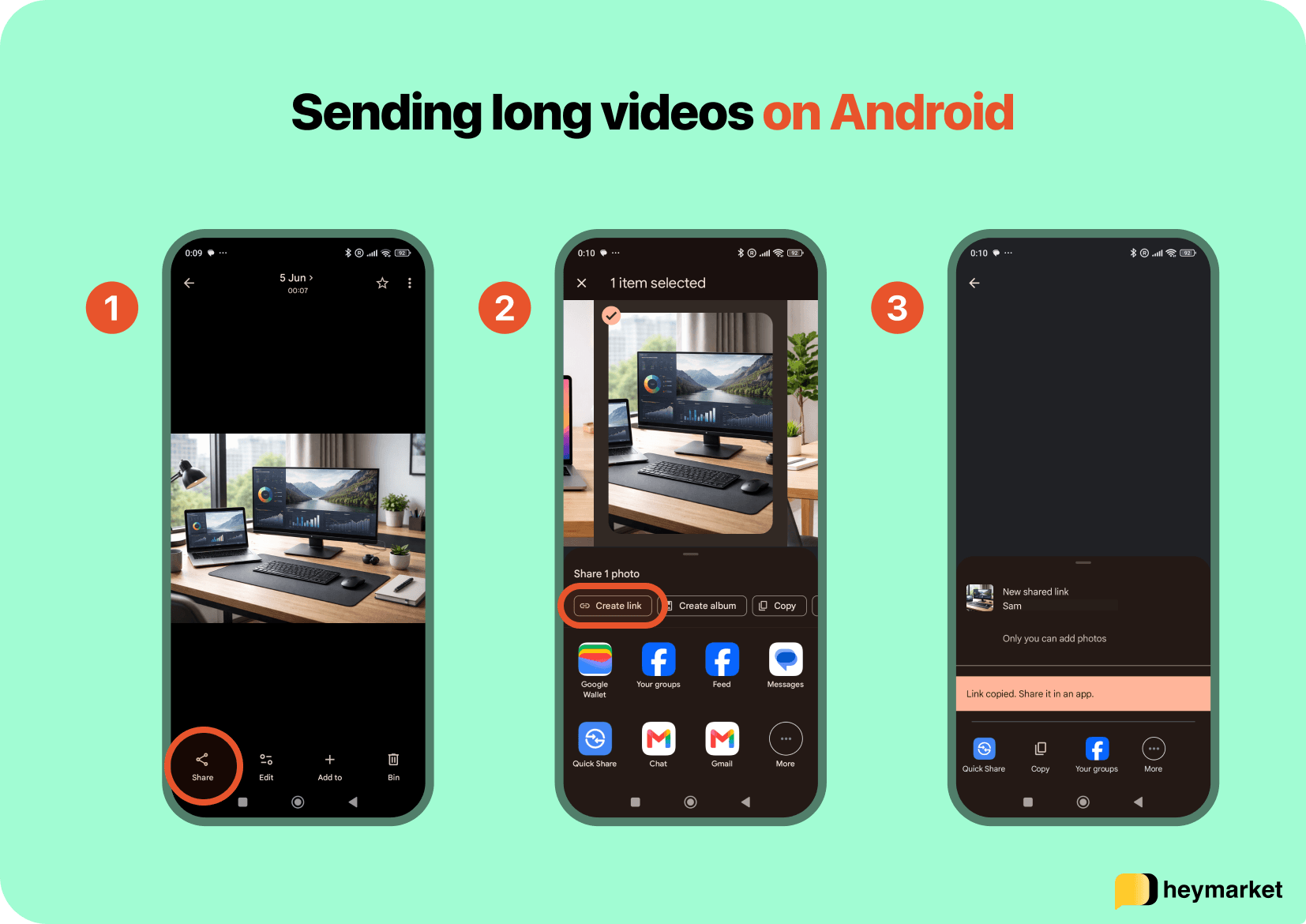
Option 1: Share a Google Photos link (best for long videos)
Attaching a longer video on Android can be unreliable, especially when file size limits or compression come into play. Sharing a Google Photos link avoids those issues by letting the recipient open the video directly, without relying on the text message to carry the full file.
- Open Google Photos and select the video you want to send. Then tap share.
- Choose Create link or select a contact to generate a shareable link.
- Copy the link and paste it into your text message.
Option 2: Attach the video in your messaging app (works for shorter clips)
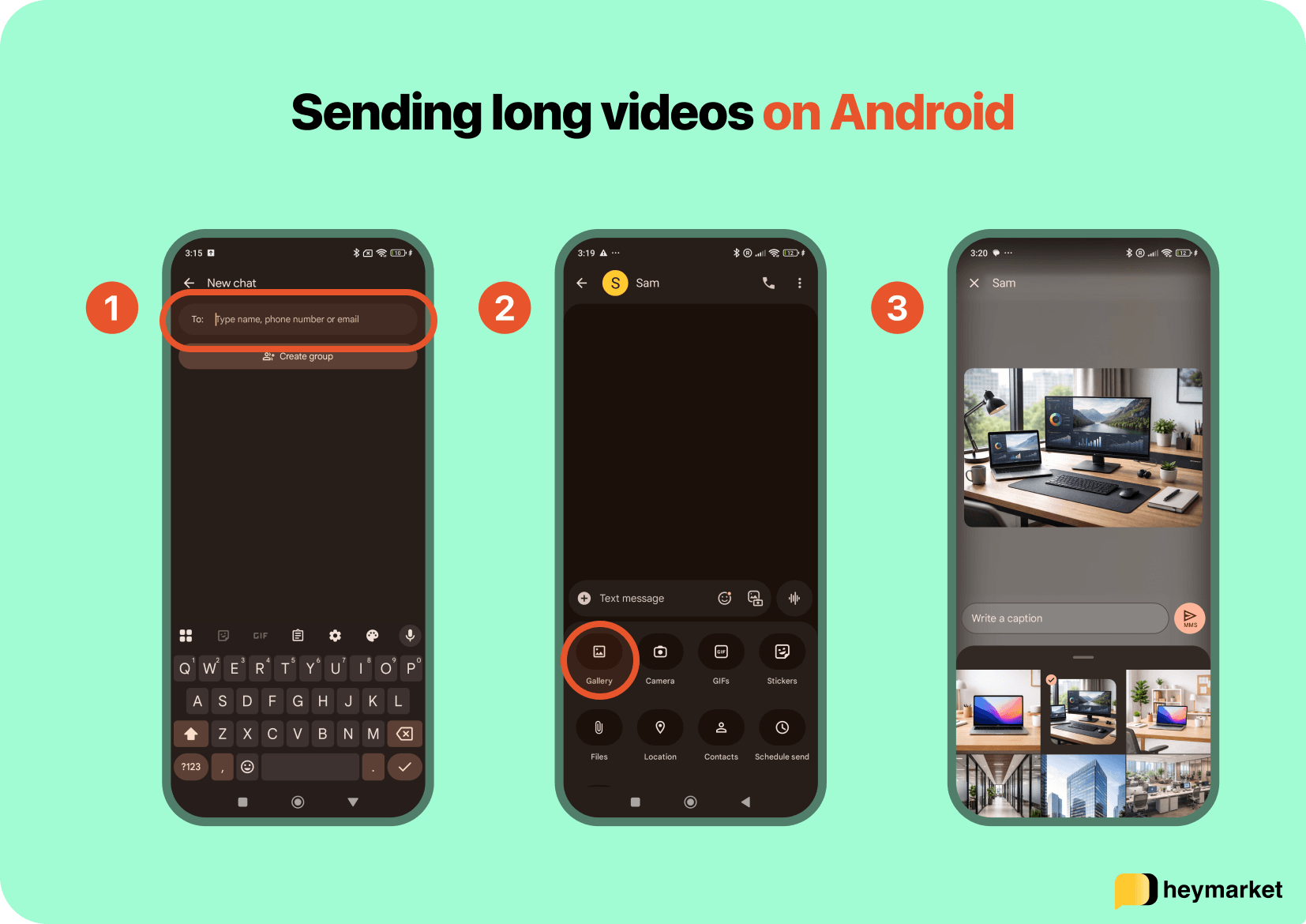
If you’re sending a shorter video and your messaging app supports richer messaging features, attaching the video directly may work:
- Open your messaging app (such as Google Messages) and select the conversation.
- Tap the attachment or media icon.
- Choose the video and send.
Sending a video between iPhone and Android
Cross-platform texting is more complicated than texting between iPhones or Android phones. Even if attaching a video works smoothly in some conversations, iPhone-to-Android conversations are more likely to run into size limits or trigger heavy compression—especially when the message is delivered using MMS.
If you want the method that works most reliably, use links for cross-platform sends. On iPhone, that means sharing an iCloud link from Photos. On Android, it means sharing a Google Photos link (or another cloud share link). Instead of forcing the text conversation to carry a large file, you’re sending access to the video in a way that’s easier for any device to open.
So if you see a “Not Delivered” notification in any of your text threads, don’t keep retrying the attachment. Switch to a link and move on.
Other ways to share videos
If both you and the recipient already use the same messaging app—such as WhatsApp or Facebook Messenger—sending the video there may be straightforward, since those apps don’t rely on SMS or MMS to deliver media. Just keep in mind that this requires both people to use the same app, and it’s a different workflow than sending a video through standard text messaging.
Best ways to share a long video link
Once you decide to send a link instead of an attachment, the next question is where to host the video. The right choice depends on what you want the recipient to do: stream it quickly, download the file, or access it privately.
If you want the simplest viewing experience, choose an option that opens easily on any phone with minimal friction. If you need more control over access, choose a storage option that lets you manage permissions.
Google Photos or iCloud links
These are usually the fastest options when you’re sending from a phone, because they’re built into the device experience. They’re ideal for one-to-one sharing when you want the recipient to tap once and watch, without dealing with downloads or logins.
Cloud storage links (Google Drive, Dropbox, OneDrive)
Cloud storage is a better fit when you want more control—such as limiting access, sharing the same file with multiple people, or sending a downloadable version of the video. This is often the most practical option for longer files that someone may need to save, forward, or reference later.
YouTube (unlisted or private)
For very long videos, YouTube can offer the smoothest playback experience because it’s designed for streaming. Uploading the video as unlisted or private can also be useful when you want a clean viewing experience without making the video broadly discoverable.
How to send videos through business texting
Business texting is one of the most efficient ways to communicate with customers and prospects—whether you’re sending reminders, updates, confirmations, or support follow-ups—once you’ve captured the right opt-in.
When it comes to video, the main decision is whether you’re sending a very short clip or something longer. Because MMS has strict size limits, we recommend attaching only very short videos (under 1 MB). For longer videos, like demos, walkthroughs, or onboarding content, it’s more reliable to send a direct link to the video instead.
Here’s how you can send videos as a business:
- Access your business texting platform.
- Navigate to your chats.
- Start a new conversation or access an existing one.
- Add the video to the message
- For files, press the attachment button and select the video from your library.
- For links, paste the link to the hosted video directly in the composer.
- Send the MMS to your contact.
You can also send mass texts with videos:
- Access your business texting platform.
- Navigate to Lists, then create or select the list of contacts you want to send the video to.
- Note: Make sure they’ve opted in to receive text messages from you.
- Create a new text and click the attachment button to add a video, or paste the direct link.
- Schedule the text or send it immediately.
You can also include videos in your text messaging drip campaigns by navigating to Campaigns, selecting a list, and then composing your series of text messages with the video attachments or direct link added on each applicable message.
Discover the right way to send a long video through text
Sending a long video through text doesn’t have to be a guessing game. The key is understanding that traditional text messaging—especially when it relies on MMS—was never built to handle modern video files reliably. That’s why attachments often fail, stall, or arrive heavily compressed, even when everything else seems fine.
The most consistent solution across iPhone and Android is to send a link for anything beyond a quick clip. If you do attach a video, keep it very short and expect that quality may be reduced. For business texting in particular, MMS works best for lightweight, under-1MB clips, while longer videos are typically better shared as a direct link so they open reliably across devices.
Want a better way to manage business texting? See how Heymarket helps teams send MMS responsibly and share video links with confidence.